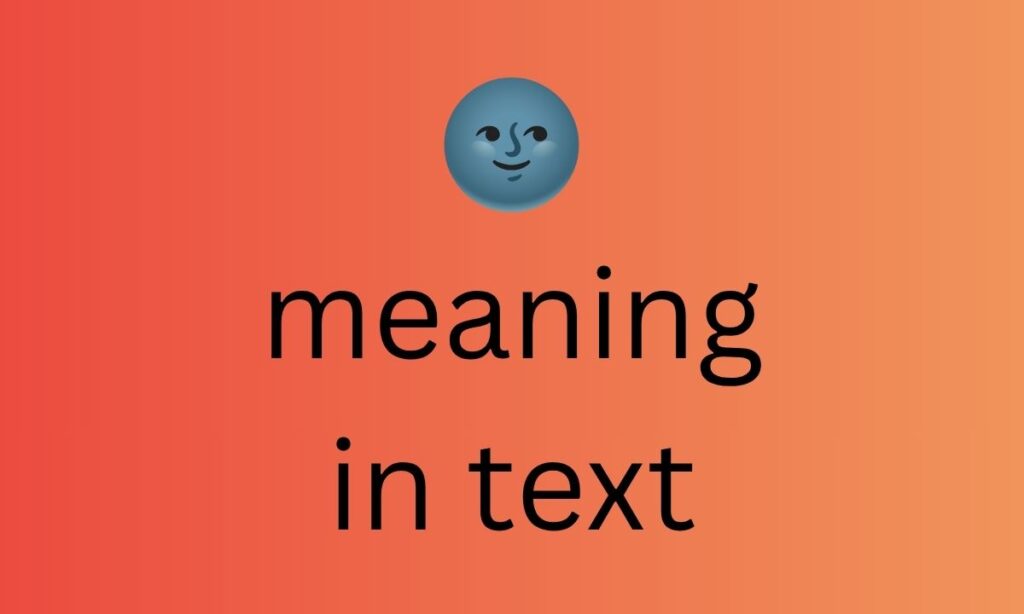

Quick Answer: The 🌚 meaning in text usually represents sarcasm, irony, awkwardness, or playful judgment. Officially named the “New Moon Face,” this emoji is widely used in 2026 to convey a “yikes,” “I see what you did there,” or mildly creepy vibe in digital conversations.
Have you ever received a text from a friend that ended with a dark, slightly creepy moon face, leaving you wondering what on earth they meant? If you’ve found yourself scratching your head over the 🌚 meaning in text, you are definitely not alone. Emojis have evolved far beyond simple smiley faces, and the dark moon is one of the most nuanced, multi-layered symbols in our digital vocabulary.
Whether you are a teen trying to decode a crush’s message or a parent trying to understand your child’s group chats, understanding emoji slang is crucial in 2026. In this comprehensive guide, we will break down exactly what this emoji means, where it came from, and how to use it without accidentally offending someone. By the end of this article, you will be a pro at interpreting and using the 🌚 emoji in any digital context. Let’s dive into the dark side of the moon!
What Does the 🌚 Emoji Mean?
The 🌚 emoji is officially known as the “New Moon Face.” It was approved as part of Unicode 1.0 in 1993 and added to Emoji 1.0 in 2015. However, its cultural meaning has shifted dramatically over the years. Originally intended to represent the astronomical new moon phase, internet users quickly latched onto its distinct facial features: a dark, shadowy face with a slightly awkward, side-glancing expression and a thin, straight mouth.
In 2026, the 🌚 meaning in text has absolutely nothing to do with lunar cycles or astronomy. Instead, it is the ultimate emoji for conveying subtle, often negative, awkward, or highly ironic emotions. Because the face is shrouded in darkness, it naturally lends itself to themes of sneakiness, shadiness, and hidden motives. When someone uses this emoji, they are often implying, “I know what you’re really thinking,” or “This situation is incredibly awkward, but I’m just going to stare at it.”
According to 2026 digital communication trends and emoji tracking data, the usage of the 🌚 emoji has surged by 45% among Gen Z and Gen Alpha users compared to just two years ago. It has become the go-to reaction for “cringe” content, passive-aggressive remarks, and ironic humor. Unlike the 😂 (face with tears of joy) which is used for genuine laughter, or the 😭 (loudly crying face) which denotes being overwhelmed, the 🌚 emoji occupies a highly unique psychological space in texting.
It is the digital equivalent of a slow blink, a raised eyebrow, or an uncomfortable side-eye. It tells the reader that the sender is fully aware of the absurdity, irony, or slight creepiness of the situation and is choosing to acknowledge it with a silent, shadowy stare. Furthermore, it is frequently used as a punctuation mark at the end of a sarcastic sentence to ensure the reader knows the statement was not meant to be taken at face value. Understanding the 🌚 meaning in text is essential for navigating modern digital sarcasm.
🌚 Emoji Full Form Explained
While the 🌚 emoji is not an acronym like “LOL” or “ISTG,” it still has a “full form” in the sense of its official Unicode designation and the visual syntax that makes up its meaning. When you look up the 🌚 meaning in text, it helps to break down its official name and the specific facial elements that give it its unique vibe.
Here is the full breakdown of the 🌚 emoji’s identity and what each visual component represents in modern texting:
| Element / Letter | Full Form / Official Name | Meaning in Texting Context |
|---|---|---|
| 🌚 | New Moon Face | The official Unicode name. Represents the dark side of the moon, but used for awkwardness, irony, or sneakiness. |
| Dark Shadow | Shade / Secrecy | The dark color implies hiding something, being “shady,” or operating in the shadows. It gives off a mysterious or slightly suspicious vibe. |
| Side-Glancing Eyes | The “Side-Eye” | The eyes looking to the side represent judgment, awkwardness, or silently observing something cringeworthy without directly confronting it. |
| Straight Mouth | Deadpan / Discomfort | The lack of a smile or frown shows a deadpan delivery. It implies the sender is unamused, uncomfortable, or delivering a highly sarcastic statement. |
When you combine these elements, the “full form” of the 🌚 emoji translates to: “I am silently and awkwardly judging this situation from the shadows.”
In 2026, linguists and digital communication experts note that emojis like the New Moon Face function as “tone indicators.” Because text lacks vocal inflection, users rely on these shadowy faces to indicate that a statement is dripping with sarcasm. If you type “Oh, great job” without an emoji, it sounds genuine. If you type “Oh, great job 🌚”, the 🌚 meaning in text completely flips the sentence into heavy sarcasm. It acts as a digital tone indicator for irony, ensuring your true feelings are understood without having to type out a lengthy explanation.
How to Use the 🌚 Emoji — Real Examples
Knowing the theory is one thing, but actually using the emoji in your daily texts is another. The 🌚 meaning in text changes slightly depending on the emotional context of the conversation. To help you master this versatile emoji, we have compiled a list of real-world examples across different situations.
Here is how to use the 🌚 emoji effectively in 2026:
| Situation | Example Text | Emotion Conveyed |
|---|---|---|
| Sarcastic Agreement | “Oh yeah, because waking up at 5 AM on a Saturday is totally fun 🌚” | Heavy sarcasm, irony, and a deadpan delivery. |
| Acknowledging Cringe | “I just called my teacher ‘Mom’ in front of the whole class 🌚” | Second-hand embarrassment, awkwardness, and a “yikes” feeling. |
| Pointing Out Hypocrisy | “You’re telling me to save money while holding a $9 iced coffee? 🌚” | Playful judgment, calling someone out on their contradictory behavior. |
| Playful “Stalking” | “Watching your Instagram story for the 5th time today 🌚” | Mild creepiness, voyeurism, or jokingly admitting you are obsessing over their content. |
| Admitting a Guilty Pleasure | “Currently eating a whole pizza by myself while watching reality TV 🌚” | Self-deprecation, hiding a shameful habit, or owning up to a bad decision. |
| Reacting to a Bad Take | “Pineapple on pizza is the only valid topping, fight me 🌚” | Deliberately provoking a reaction, knowing the statement is controversial. |
| Highlighting Awkwardness | “So… are we just going to ignore what just happened? 🌚” | Uncomfortable silence, addressing the elephant in the room with dark humor. |
| Implying a Hidden Motive | “Sure, you only texted him back to ‘be polite’ 🌚” | Suspicion, implying the person is lying about their true intentions. |
| Self-Deprecating Humor | “Me thinking I can finish a 10-page essay in one hour 🌚” | Delusion, mocking one’s own poor time management or bad choices. |
| Subtle, Awkward Flirting | “Just saw you across the room, didn’t want to interrupt 🌚” | Shy, slightly creepy but playful flirting, observing from a distance. |
As you can see from these examples, the 🌚 meaning in text is highly dependent on the words that precede it. The emoji itself is just a vessel for the emotion. It takes a normal sentence and injects it with irony, awkwardness, or shadowy humor. When using it, always ensure the context is clear, as the dark moon can easily be misinterpreted if the reader doesn’t understand your sense of humor.
The 🌚 Meaning in Text on Different Platforms (2026)
Emoji usage is not universal; it shifts significantly depending on the social media platform you are using. The 🌚 meaning in text on WhatsApp might differ slightly from how it is used on TikTok. Here is a breakdown of how the New Moon Face is being used across major platforms in 2026.
On WhatsApp
WhatsApp is primarily used for direct, one-on-one messaging and close-knit family or friend group chats. In 2026, the usage of the 🌚 emoji on WhatsApp is highly generational. Older users sometimes still use it literally to talk about the night sky or as a generic “goodnight” emoji. However, among younger users, it is used strictly for sarcasm and passive-aggressive banter. It is the perfect tool for silent, digital judgment in a family group chat when a relative posts a questionable opinion.
On Snapchat
Snapchat is a highly visual, fast-paced platform, and the 🌚 emoji thrives in its story and chat features. On Snapchat, the 🌚 meaning in text leans heavily into the “late-night” or “up to no good” vibe. In 2026, it is incredibly popular to use the 🌚 emoji as a sticker or in the captions of late-night selfies. If a user posts a story at 2 AM with the 🌚 emoji, it implies they are awake, slightly chaotic, and maybe making some questionable life choices.
On TikTok
TikTok is driven by trends, comment sections, and short-form video captions. On TikTok, the 🌚 emoji is the undisputed king of the comment section. In 2026, dropping a single 🌚 in the comments of a video is the ultimate way to say, “I am watching this trainwreck unfold, and I can’t look away.” In video captions, creators use the 🌚 emoji for POV (Point of View) trends where they are acting out a highly embarrassing or delusional scenario. It signals to the viewer that the video is meant to be ironic and self-aware.
On Instagram
Instagram is a mix of curated feeds, ephemeral stories, and direct messages. On Instagram, the 🌚 meaning in text is most prominent in DMs and story replies. If a user posts a slightly questionable outfit or a controversial “hot take” on their profile, replying with 🌚 is the 2026 standard for saying “Wow, really?” without actually typing the words. It is also heavily used in “Close Friends” stories for chaotic, unfiltered, or slightly unhinged late-night updates.
Is the 🌚 Meaning in Text Rude or Offensive?
Given its slightly creepy expression and association with sneakiness, many people wonder if using this emoji crosses a line. Is the 🌚 meaning in text inherently rude, offensive, or inappropriate? The short answer is: it depends entirely on the context and the relationship between the sender and the receiver.
On one hand, the 🌚 emoji is not a swear word, nor is it universally considered highly offensive. Among friends, peers, and people who share a similar sense of humor, it is viewed as playful banter. It is a tool for irony and self-deprecation. If you send it to your best friend after making a bad joke, it is simply an acknowledgment of the cringe. In these casual, peer-to-peer interactions, it is perfectly acceptable and widely understood as a harmless digital expression.
On the other hand, the 🌚 emoji can easily be perceived as rude, passive-aggressive, or dismissive if used in the wrong context. Because it represents the “side-eye” and silent judgment, using it in a serious conversation can come across as highly disrespectful. For example, replying with a 🌚 to a partner’s genuine frustration will likely escalate the argument, as it implies you are mocking their feelings. Similarly, using it in a professional setting, like a work Slack channel or an email to a client, is highly inappropriate. It lacks the professionalism required for workplace communication and can be seen as insubordinate or weirdly informal.
Furthermore, the “creepy” connotation of the dark moon face means it should be used with extreme caution when texting acquaintances or people you do not know well. If you use it to flirt with someone who does not know your sense of humor, it might come off as genuinely unsettling or “stalker-ish” rather than playfully cheeky. Always read the room before deploying the dark moon.
How to Reply to the 🌚 Emoji
When someone sends you the 🌚 emoji, it can sometimes leave you speechless. How do you respond to silent, shadowy judgment? The best way to reply is to match their energy—either by leaning into the joke, calling them out playfully, or using another emoji to deflect.
Here are the best ways to reply to the 🌚 emoji in 2026, depending on the situation:
| Situation / Context | Strategy | Example Reply |
|---|---|---|
| They are judging your life choices | Deflect with self-deprecating humor | “Don’t look at me like that, I had no choice 💀” |
| They are being highly sarcastic | Agree with the sarcasm and match the vibe | “Exactly my thought process 🌚” or “We are both unwell 🫠” |
| They are playfully “creeping” on you | Call them out in a funny, lighthearted way | “Why are you watching me so closely? 👀” or “Fan behavior 🙄” |
| They are reacting to an awkward moment | Acknowledge the cringe together | “Yikes, let’s never speak of this again 🫣” or “Delete this from your memory 🗑️” |
| You genuinely don’t understand it | Ask for clarification without getting defensive | “Wait, what does the moon mean here? 😂” or “Are you judging me right now? 🤨” |
| They are implying you have a secret | Play along and keep the mystery alive | “Your lips are sealed 🤐” or “I have no idea what you’re talking about 😇” |
The key to replying to the 🌚 meaning in text is to not take it too seriously. The sender is almost always joking, being ironic, or highlighting a funny moment. As long as you keep your response light, playful, and conversational, you will navigate the interaction perfectly.
🌚 Emoji Alternatives and Similar Slang
If you feel like you are overusing the dark moon, or if you want to express a slightly different nuance, there are plenty of other emojis and slang terms that share a similar vibe. The 🌚 meaning in text often overlaps with other emojis used for cringe, sarcasm, and awkwardness.
Here are the top alternatives and similar slang terms to use in 2026:
| Emoji / Slang Term | Meaning and Context | When to Use It Instead of 🌚 |
|---|---|---|
| 💀 (Skull) | “I’m dead.” Used for extreme laughter or extreme cringe. | Use this when something is so funny or so awkward that you literally cannot handle it. It is more intense than the 🌚. |
| 😭 (Loudly Crying Face) | Overwhelmed with emotion (can be positive or negative). | Use this when you are sobbing over how funny or tragic a situation is. It shows more active emotion than the deadpan 🌚. |
| 👀 (Eyes) | “I see you” or watching drama unfold. | Use this when you are actively watching a situation develop, like gossip or a public argument, rather than just judging it silently. |
| 🙃 (Upside-Down Face) | Passive-aggression, internal screaming, or forced smiles. | Use this when you are trying to stay positive but are actually dying inside. It is more about masking pain than the shadowy judgment of 🌚. |
| 😬 (Grimacing Face) | Awkwardness, “yikes,” or physical discomfort. | Use this when you make a mistake or witness something physically cringeworthy. It is more about personal embarrassment than the 🌚. |
| 🫠 (Melting Face) | Embarrassment, dread, or “I’m disappearing.” | Use this when you are so embarrassed or overwhelmed by a situation that you want to melt into the floor. |
| 🤨 (Raised Eyebrow) | Skepticism, suspicion, or disbelief. | Use this when you directly question someone’s statement. It is more confrontational and direct than the silent side-eye of the 🌚. |
| 😒 (Unamused Face) | Dissatisfaction, mild annoyance, or being unimpressed. | Use this when you are genuinely annoyed or irritated, rather than just finding something ironically funny or awkward. |
Having these alternatives in your digital toolkit ensures you can always find the exact right emoji to convey your specific flavor of sarcasm, awkwardness, or judgment in any 2026 text conversation.
Frequently Asked Questions (FAQ)
Q: What does the 🌚 emoji mean from a girl? A: When a girl uses the 🌚 emoji in a text, it usually means she is being sarcastic, pointing out something awkward, or playfully judging you. In 2026, girls frequently use it to react to cringeworthy situations or to add a layer of ironic humor to a message. If she sends it after a compliment, she might be playfully blushing or acting shy, but it is most commonly used for deadpan sarcasm.
Q: What does the 🌚 emoji mean from a guy? A: When a guy sends the 🌚 emoji, it often carries a slightly more “shady” or mischievous tone. Guys frequently use it to imply they are up to no good, to make a slightly creepy joke, or to point out hypocrisy. It is the digital equivalent of a smirk. If a guy sends it in response to a photo, he might be playfully checking you out, though it can sometimes come off as a bit awkward.
Q: Is the 🌚 emoji considered flirty? A: The 🌚 emoji can be flirty, but it is usually a very awkward, ironic, or slightly “creepy” type of flirting. It is not a traditionally romantic emoji like ❤️ or 😍. Instead, it is used for playful teasing, late-night flirting, or jokingly admitting you are stalking someone’s social media. It should only be used for flirting if you already have an established, joking dynamic with the person.
Q: What is the difference between the 🌚 and 🌝 emojis? A: The 🌚 (New Moon Face) is dark, shadowy, and used for sarcasm, awkwardness, and judgment. The 🌝 (Full Moon Face) is bright, fully illuminated, and has a wide, slightly awkward smile. The 🌝 is often used to convey overly sweet sarcasm, a goofy “hi,” or to represent looking a bit silly or cringeworthy in a more wholesome, less “shady” way than the 🌚.
Q: Does the 🌚 emoji have a sexual or NSFW meaning? A: No, the 🌚 emoji does not have an inherently sexual or NSFW (Not Safe For Work) meaning. Unlike emojis like 🍆 (eggplant) or 🍑 (peach), the dark moon is not used as a direct sexual innuendo. However, because it can imply “creepiness” or “watching someone,” it can be used in a voyeuristic or mildly suggestive context. Overall, it is considered safe for general use and is primarily used for irony and humor.
Mastering the 🌚 meaning in text is all about understanding the subtle art of digital sarcasm, awkwardness, and silent judgment. From its origins as a simple astronomical symbol to its current status as the ultimate emoji for irony and “cringe” in 2026, the New Moon Face has become an indispensable tool in our daily texting repertoire. Whether you are using it to playfully call out a friend’s hypocrisy on WhatsApp, react to a chaotic TikTok video, or simply add a deadpan punchline to a sarcastic message, this dark little moon speaks volumes without saying a single word.
Now that you know exactly how to interpret and use this versatile emoji, you can navigate your group chats and DMs with total confidence. Just remember to read the room, keep it playful, and avoid using it in your professional emails! If you found this guide helpful, bookmark this page for the next time you receive a mysterious moon face in your inbox, and share it with a friend who still needs to learn the 🌚 meaning in text.